
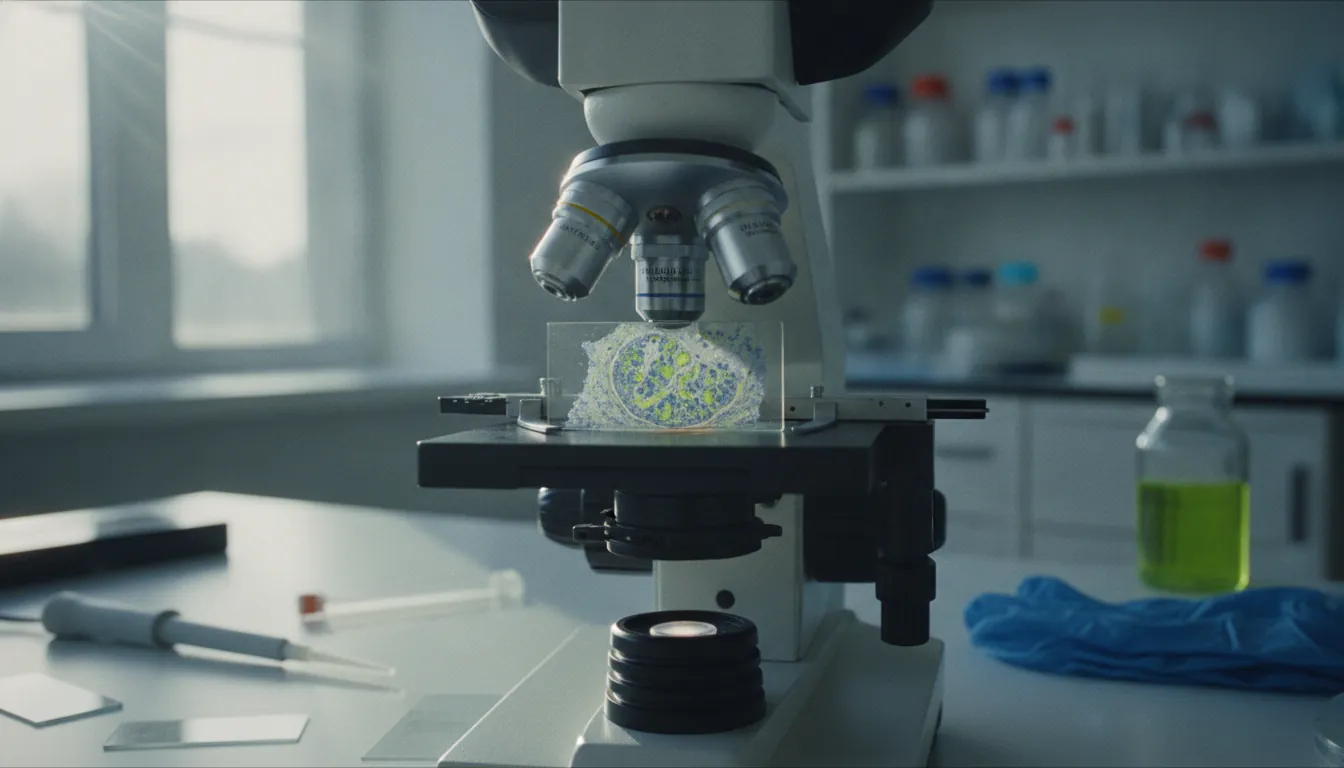
 AI-generated from publicly available materials.
Researchers at UCLA have introduced an innovative approach to breast cancer diagnostics by combining uncertainty-aware AI with lensfree holographic imaging for automated HER2 assessment.
This new computational pathology platform leverages a compact lensfree imaging system that captures diffraction patterns from stained breast tissue samples. By employing deep learning techniques with Bayesian uncertainty quantification, the system not only predicts HER2 scores but also assesses the confidence of those predictions. This dual capability allows for the identification of uncertain cases, enhancing the reliability of clinical decision-making.
HER2 is a crucial biomarker in breast cancer treatment, and accurate scoring is essential for effective patient management. Traditional digital pathology methods often require expensive optical systems, which can limit accessibility. The UCLA platform addresses these challenges by providing a high-throughput, cost-effective solution that maintains diagnostic accuracy comparable to conventional microscopy.
The results from a study involving 412 breast tissue samples demonstrated an impressive accuracy of 84.9% for four-class HER2 scoring and 94.8% for binary classification. The integration of uncertainty quantification further reduced errors by 30.4%, underscoring the potential of this technology to improve diagnostic processes. As noted by Prof. Aydogan Ozcan, the goal is to create reliable diagnostic tools that can operate effectively in both advanced and resource-limited healthcare environments, paving the way for broader adoption of AI-assisted diagnostics in oncology.