
 Paulina Gozdzialska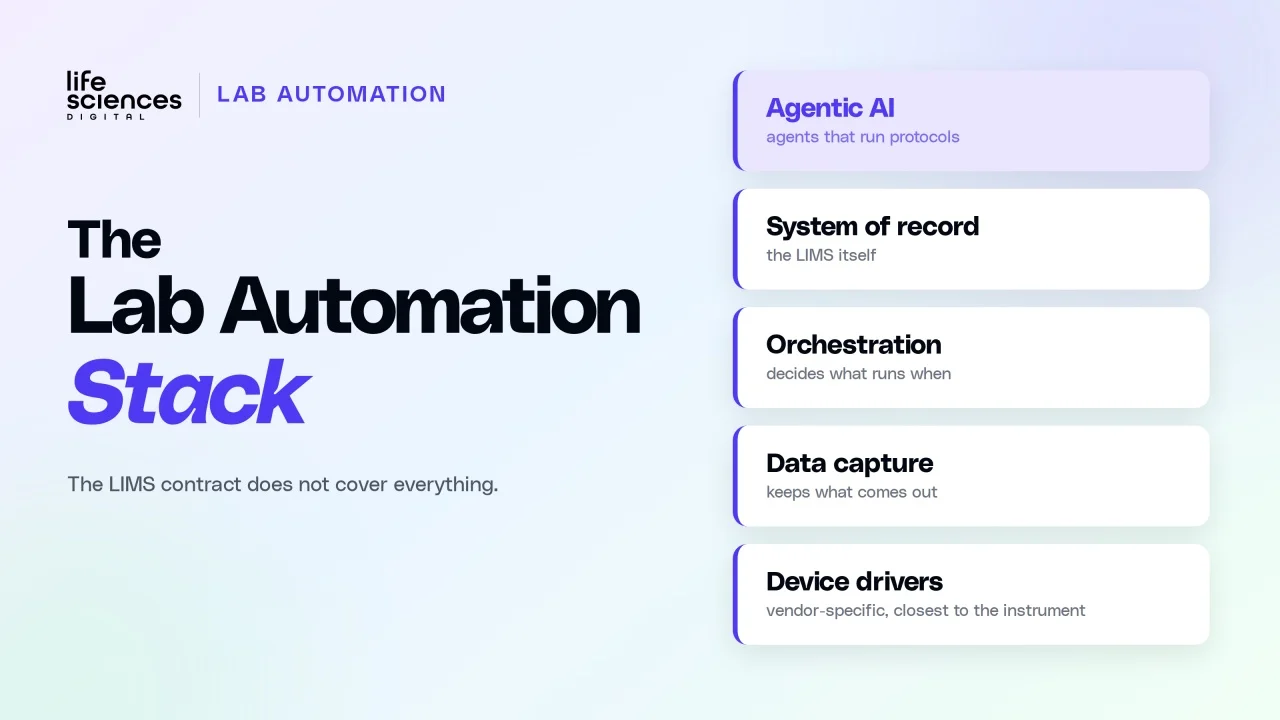
Most of the tools in our database are plumbing - workflow automation and integration middleware - and the value sits in moving data between instruments and systems of record reliably.
The market serves two opposite buyers - academic R&D optimising for flexibility, regulated pharma optimizing for formality - which is why no single standard has emerged to rule everything.
Four standards now belong on procurement checklists: SiLA 2 and LADS OPC UA at the communication layer, AnIML and Allotrope at the data layer, and the communication standard you pick today shapes which AI ecosystem you can join later.
In our Life Sciences Digital software directory, the subdomain Lab Automation & Instrument Integration sits inside the Lab Informatics & Operations domain and currently holds 80 tools.
Some time ago I got first-hand insights relevant to this category by attending one of the meet-ups of the Berlin Lab Automation Community, where experts shared their experience straight from the field. Or straight from the lab, should I say. It turned out that robots are cool (Sekels GmbH presented a magnetic particle mover that manipulates matter with precision at the micro- and nanometre scale, which is genuinely impressive hardware). But what often determines how much of that hardware actually gets used is the software layer. The part that tends to get much less attention.
Below are my learnings from the five presentations combined with some observations made for this category in our database. If you are interested in this topic, you can join the Berlin Lab Automation Community for first-hand insights.
Much of the work is plumbing
Of the 80 tools currently listed, 33 are classified as workflow automation and 28 as integration middleware. That is 61 of 80. Analytical platforms account for 10, which is somewhat less than one could assume.
When someone asks what lab automation software actually does, the simplified answer is: much of it moves data between instruments and the systems that record what happened. The value is in making that movement reliable, auditable, and vendor-agnostic.
A presentation from wega Informatik AG framed this well at the meetup describing two maturity ladders every lab climbs at once:
The hardware ladder: From walk-up manual instruments, to unattended machines, to dedicated liquid handlers, to interconnected robotic work cells.
The software ladder: From paper, to standalone LIMS, to LIMS receiving manually triggered data, to full LIMS-orchestrated automation.
Many labs sprint up the hardware ladder and crawl up the software one. The gap between the two is where automation projects may lose their promised ROI. Our category mix reflects a practical reality: buying a LIMS does not automatically give a lab an orchestration and device-integration layer.
The vendors themselves increasingly reflect this layered architecture in their products. Ginkgo Bioworks's Catalyst Platform, listed in the Lab Automation & Instrument Integration subcategory, ships as Catalyst Orchestrator for automation control and scheduling and Catalyst Agent for natural-language execution. Ginkgo's own engineering description of what Catalyst covers is telling: hardware driver interfaces, orchestration, data APIs, and agentic workflows. These are distinct problems, even when they ultimately need to work as one system.
A LIMS typically acts as a system of record. Orchestration decides what runs when. Device drivers make the instrument speak, and they are often vendor-specific, which can be a reason integration projects stall for months. Data capture keeps what comes out, and what looks like an implementation detail can become a messy scientific data-lake problem later.
Several distinct functions, often spread across multiple products. And buyers who assume the LIMS contract covers all four can end up running the last one on shared network drives and PDFs.
The market has two very different automation priorities
Broadly speaking, lab automation serves two buyers with almost opposite priorities:
Academic and early R&D labs prioritise flexibility over formality. They change protocols on the fly, write custom Python, and swap instruments often. They care about speed and vendor-neutrality, not validation packs.
Regulated pharma and QC labs prioritise formality over flexibility. In a GxP environment, plugging in a new instrument or changing a line of code means weeks of change control. They want stability, rigid audit trails, and plug-and-play validation.
That split helps explain why no single standard has emerged to rule everything. The market is not looking for one universal answer; it is solving different integration problems for different laboratory environments.
The standards conversation has moved to procurement
Standards have moved from working-group slideware to procurement checklists. If your next liquid handler cannot talk to your orchestration layer through a recognised or otherwise supported protocol, you may be paying for a custom integration and that cost often gets buried in professional services.
Four standards are worth knowing, operating at two distinct layers.
1. The communication layer (how devices talk in real time)
SiLA 2: A modern, open standard built around HTTP/2 and designed for vendor-neutral lab integration. It is royalty-free and offers open-source SDKs for Python, C#, and Java, making it particularly attractive in academic and discovery R&D environments. It also tells you something about where these tools live: SiLA 2 added a server-initiated connection method specifically so instruments sitting behind a laboratory firewall can reach an outside client without opening inbound ports.
LADS OPC UA: Released in January 2024 and available without licensing fees for the specification itself. Developed as an OPC UA companion specification through a joint working group of the OPC Foundation, SPECTARIS, and the VDMA. This is the option with particularly strong relevance for industrial and regulated environments. The presentation from Laboperator made the case at the meetup for why companies should be glad to adopt it: it inherits the OPC UA ecosystem, which the OPC Foundation says spans over 1000 member organisations across industrial automation, IIoT, and pharmaceutical sectors, making it stable, secure, and suited to high-compliance production facilities.
2. The data layer (how results are stored)
AnIML: An open ASTM XML standard for analytical chemistry and biological data, developed under ASTM subcommittee E13.15. It provides a structured format for storing and exchanging analytical data and can complement a communication standard like SiLA 2 by giving analytical results a structured format to land in.
Allotrope (ADF, AFO, ADM): Built by the Allotrope Foundation, a consortium of pharmaceutical, device-vendor, and software companies developing the Allotrope Data Format, Foundation Ontology, and Data Models. Its ontology-driven, FAIR-oriented approach is particularly relevant to commercial pharma.
The key insight: the communication and data layers do not compete. A useful way to think about the landscape is that SiLA 2 and AnIML can be particularly attractive in flexible R&D environments, while LADS and Allotrope are especially relevant to industrial and regulated pharma environments.
AI in the lab is already shipping
AI in lab automation is often framed as a future story. Our April 2026 classification suggests otherwise: 38 of the 80 tools in this category are already flagged as AI-powered, and agentic tooling is catalogued as production software.
Ginkgo Bioworks ships Catalyst Agent, a conversational AI that translates natural-language intent into lab automation scripts and manages protocols around the clock for closed-loop operation. Briefly Bio offers a natural-language interface for composing and automating protocols across automated systems. Ganymede treats instrument connectivity as version-controlled Lab-as-Code.
For where this heads, look at Lila Sciences, backed by Flagship Pioneering (the firm behind Moderna). Lila spent roughly two years inside Flagship and emerged from stealth in March 2025 with a $200 million seed round. It later raised another $350 million across two Series A tranches, bringing total funding to $550 million, with NVIDIA's venture arm among the backers.
Lila is not building another SaaS tool. Its physical "AI Science Factories" are automated labs where AI generates a hypothesis, robotics execute the experiment around the clock, and the resulting data feeds back to design the next step, forming a closed loop. It answers a real bottleneck, which is that the best models are running short of high-quality data to learn from, so Lila gives the model a physical body to generate its own.
In our database Lila's commercial offering does not sit under lab automation at all. It sits in Research Intelligence & Discovery, as an autonomous AI research agent. The model is closer to lab-as-a-service: instead of selling another standalone layer for a customer's lab, Lila is building autonomous scientific infrastructure where AI, software and laboratory hardware operate as one system.
If that model works, a share of the buyers who would have spent the next decade climbing the software ladder will simply rent someone else's finished one.
An AI model cannot think a robotic arm into moving. It needs a translation layer: the hardware-to-software plumbing. The communication standards you choose for your equipment stack become part of the substrate that agentic systems will run on later. If you procure instruments in 2026 without asking about that standard, you are not just buying a future integration bill; you may also be narrowing which AI ecosystem you can join later.
Regulation puts a price on manual data entry
Automation can deliver substantial returns: fewer hours pipetting, more reproducible runs and less manual data handling. But a regulated lab carries one cost a research lab never sees, and it is written into the rules.
EU GMP Annex 11, Clause 6, states that for critical data entered manually there should be an additional check on the accuracy of the data, and that this check may be done by a second operator or by validated electronic means. The second-operator route is what people call the four-eyes principle. 21 CFR Part 11 addresses the controls around electronic records and electronic signatures in FDA-regulated contexts. Worth keeping straight that Annex 11 is an EU GMP guideline, while 21 CFR Part 11 is a US regulation.
Every critical number a human types can trigger an additional verification step, while validated electronic capture can provide the required additional check without relying on a second operator. Every measurement that arrives automatically, timestamped and audit-logged, is one fewer measurement needing a second pair of eyes.
The catch is that the electronic alternative must be validated, and that qualifier runs the length of the chain: instrument, driver, orchestrator, system of record. When those functions are spread across multiple systems, the validation effort also has to cover the interfaces and the end-to-end data flow between them.
Six questions for your next RFP
If you are procuring lab equipment or automation software, put these in your user requirement specification:
What communication standard does this instrument support? SiLA 2, LADS OPC UA, both, or neither?
If neither, who pays for the custom driver work?
What structured format do results come out in, and can that data be exported without buying a paid module?
Is the device driver documented and accessible, and who controls its maintenance and lifecycle?
Does the vendor offer a validated integration with your specific LIMS, ELN, or orchestration platform, and what exactly does that validation cover?
Who owns the data the instrument produces, and what are the export terms if you switch vendors later?
The lesson from the category is that automation is not just about making machines move. It is about making machines, software and data work together reliably.
The global lab automation market is worth roughly USD 6.6 billion in 2026 by MarketsandMarkets' estimate. Most of that money buys hardware. How much value hardware can generate depends on the software layer connecting it to everything else.

Sources & references
Life Sciences Digital classification. Category counts, tool-type mix and AI-powered share. Source: April 2026 classification.
Ginkgo Bioworks, Catalyst Platform / Orchestrator / Agent. Sources: Life Sciences Digital product record; Ginkgo software documentation.
Lila Sciences, Lila Catalyst. Source: Life Sciences Digital product record.
SiLA 2. 2018 release; gRPC/HTTP/2; royalty-free; gateway architecture; server-initiated connections. Sources: Lab Automation Wiki; Tecan SiLA2 SDK paper (SLAS Technology); SiLA Consortium; Wiley Analytical Science.
LADS OPC UA. January 2024 release; OPC Foundation / SPECTARIS / VDMA working group; free to adopt. Sources: SLAS Standards; OPC Foundation.
LADS and Allotrope interoperability demonstration. AFO and ASM integrated into the LADS OPC UA framework; demonstrated at the 8th LADS hackathon on 11 April 2025, announced 14 May 2025. Source: OPC Foundation.
AnIML. ASTM XML standard; subcommittee E13.15; FAIR. Sources: AnIML (official); De Gruyter, "Data format standards in analytical chemistry."
Allotrope. ADF / AFO / ADM and consortium background. Sources: Allotrope Foundation; ACD/Labs.
Lila Sciences. Funding and valuation (historical rounds); AI Science Factories; NVIDIA backing; ~$2B round reported in talks mid-2026 at ~$8.5B valuation. Sources: Reuters; FierceBiotech; Lila Sciences newsroom; Flagship Pioneering; Bloomberg
Regulatory. EU GMP Annex 11, Clause 6; four-eyes principle; distinction between Annex 11 (EU guideline) and 21 CFR Part 11 (US regulation). Sources: Pharmaceutical Technology; SimplerQMS; Vaisala.
Market size. ~USD 6.6B global lab automation market in 2026. Sources: MarketsandMarkets; GlobeNewswire, 1 July 2026.