
 Paulina Gozdzialska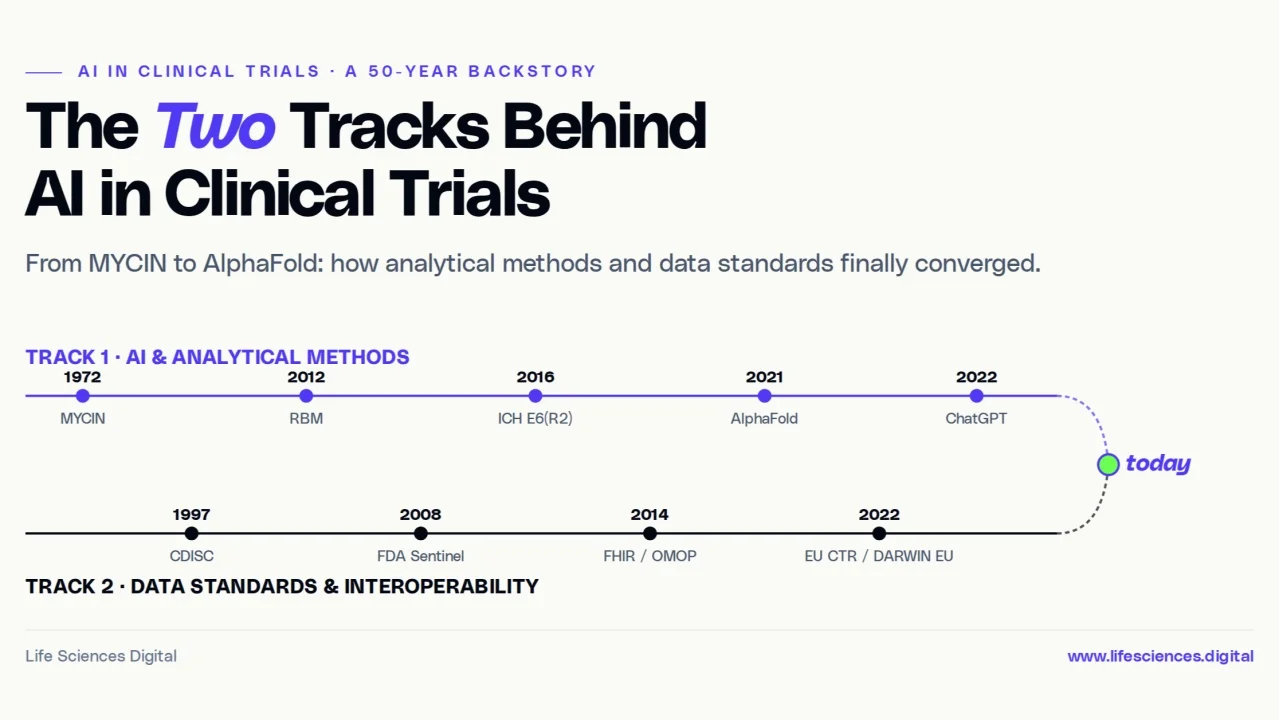
AI in clinical trials didn't arrive suddenly - it's the convergence of two parallel tracks, analytical methods and data standards, that each took roughly five decades to mature.
Data infrastructure (CDISC, MedDRA, FHIR, OMOP, Sentinel) was the silent precondition: without shared standards and interoperable sources, no model would generalise across studies, sponsors, or countries.
The ten AI types in active use are not interchangeable - a rule-based edit check, a Bayesian adaptive design, and an LLM drafting a CSR require fundamentally different validation, governance, and infrastructure.
Validation itself has to shift from traditional CSV to Computer Software Assurance (CSA) to handle the non-deterministic nature of AI, with the EU AI Act now classifying many clinical AI tools as high-risk.
What looks like a sudden transformation is the result of two parallel tracks built over five decades. One track is about AI and analytical methods. The other is about data standards and interoperability. Neither alone was sufficient. Both had to mature at the same time.
I recently attended a session on this history. Not the hype version. The infrastructure version. Here is what it covered.
Track 1: AI and analytical methods in clinical research
The first expert system applied to medicine was MYCIN, built at Stanford between 1972 and 1977. MYCIN diagnosed bacterial infections and recommended antibiotics using a set of "if-then" rules defined by physicians. It was never deployed clinically, but it proved something important: a computer could reason on medical rules. That was the first crack in the wall.
The 1980s and 1990s saw expert systems mature in narrow domains and the foundations of machine learning emerge, but none of it crossed into routine clinical trial operations. The shift that mattered operationally came between 2012 and 2014, when TransCelerate BioPharma Inc. launched its Risk-Based Monitoring initiative. For the first time, the industry accepted that you do not need to visit every site on a fixed schedule. You visit where data tells you risk is elevated. That is a data-driven logic, and it required analytics to function. Without RBM, the idea of an algorithm guiding monitoring would have had no regulatory or operational home.
In 2016, two things happened. First, ICH E6(R2) was published, the updated GCP addendum that formally introduced quality management and risk-based approaches into the global standard for clinical trials. That update legitimised the use of analytics and, later, ML in oversight of trial data and processes. Regulators said: yes, algorithms can be part of how you run a study. Second, IBM Watson for Clinical Trial Matching was deployed, one of the first widely communicated uses of NLP to match patients to trials based on eligibility criteria and EHR data. The results were mixed, but the use case was established.
In 2017, TransCelerate's eSource Initiative addressed something quieter but equally important: getting data directly from electronic sources, EHR systems, devices, and vendors, without manual transcription. This increased both the volume and the machine-readability of clinical data. AI needs clean, structured data in large quantities. eSource was a supply chain decision as much as a technology decision.
By 2020, Medidata and Acorn AI had commercialised AI for trial operations: risk forecasting, study design support, and Synthetic Control Arms, an approach that uses AI-processed historical data in place of a traditional control group. This is particularly relevant for rare diseases, where recruiting patients to a control arm is difficult or raises ethical concerns.
Then came the two events most people do know. In 2021 and 2022, AlphaFold and AlphaFold Protein Database resolved a 50-year-old problem in structural biology: predicting how proteins fold. This is not a clinical trial tool directly, but it changed the upstream pipeline. Faster and cheaper molecular design means more drug candidates entering development, and more candidates means more trials, sooner. In 2022, ChatGPT and the era of large language models arrived: fast summarisation, information extraction, protocol drafts, CSR writing, Q&A on documentation.
The most recent regulatory milestone is the FDA's Guidance on Conducting Clinical Trials With Decentralized Elements, finalised in 2024. That guidance formalised the framework for trials that collect data through remote visits, wearable devices, and home-based procedures. It is a significant addition to the analytical toolkit, because decentralised trials generate more diverse data streams, which in turn require more AI to integrate, monitor, and assess.
Track 2: Data standards and interoperability
Parallel to all of the above, a second set of developments was making it possible for AI to actually work on clinical data at scale.
In 1997, CDISC, the Clinical Data Interchange Standards Consortium, began the work of standardising clinical data. The idea: data from a study should be interpretable by any system and any company, from protocol to analysis. Without CDISC, models trained on one company's data would not generalise to another's. In 1999, the first public release of MedDRA arrived, a common dictionary for adverse event terminology. Without a shared vocabulary for safety data, integrating information across sponsors, sites, and regulators would be semantically impossible. Everyone would be describing the same thing in different words.
In 2000, ClinicalTrials.gov launched, creating a public registry of clinical studies. Beyond transparency, it became a structured data source for anyone analysing trial trends, competitive intelligence, and recruitment patterns. In 2003 the preliminary draft was published, and SDTM v1.0 was formally approved by the FDA in 2004. This standardised the structure of datasets submitted to regulators. Practically, it enabled scalable integration and standardisation of data across multiple studies. Before SDTM, every study had a different table structure, which made cross-study machine learning close to impossible.
In 2008, the FDA launched its Sentinel Initiative, a data network for large-scale post-market safety surveillance using real-world data from insurers, hospitals, and pharmacies. The model was federated: data stays with the owner, analyses run centrally. This became the architectural blueprint for later RWE networks and privacy-preserving approaches to training AI on sensitive data.
Between 2011 and 2014, HL7 FHIR moved from draft to its first stable release. FHIR is the technical standard that makes electronic health records portable across systems. It moved the conversation from 'how to send a file' to 'how to access a specific data point' via APIs, which is the oxygen for real-time AI. It is the bridge between the healthcare system and the clinical trial, enabling eSource, electronic recruitment, and remote visits. Without FHIR, AI operating on hospital data would be working from a different source every time.
In 2014, OHDSI and the OMOP Common Data Model established a shared structure for observational and real-world data. This made it possible to run analyses across data from different hospitals and countries using the same model. External control arms, hybrid trial designs, and cross-national AI studies depend on this comparability. From 2016 to 2018, the 21st Century Cures Act and the FDA's subsequent RWE programme created regulatory pressure to use real-world data as evidence of drug safety and efficacy. This forced the industry to invest in data quality, provenance, and governance, which are direct prerequisites for AI that operates on real-world sources.
In 2022 and 2023, the EU Clinical Trials Regulation and the CTIS portal came into effect, creating a central application and oversight system for all clinical trials across the EU and EEA. For AI purposes, this means a centralised, standardised data layer for European trial activity. From 2022 to 2025, the European Medicines Agency's DARWIN EU network has been building a European infrastructure for generating real-world evidence from hospitals, registries, and administrative databases across multiple member states. The stated goal is integrated evidence across the full lifecycle of a medicinal product. This is the European counterpart to FDA Sentinel, broader in scope and with the ambition to feed regulatory decisions with near-real-time real-world data.
10 types of AI, each doing a different job
With both tracks mature, the question becomes practical: which AI is doing what work in clinical trials today? The session distinguished ten types in active use
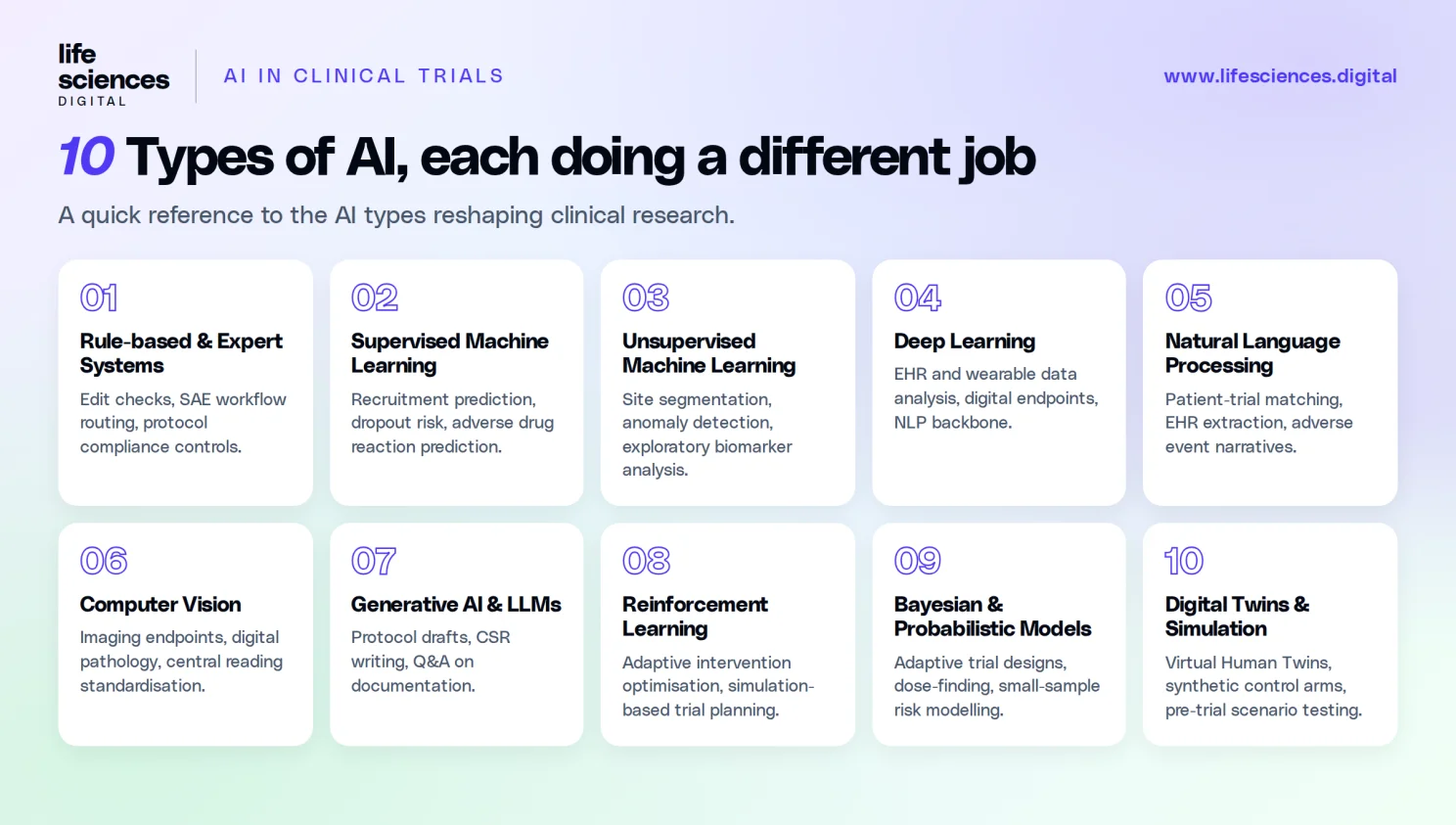
Rule-based and expert systems operate on fixed logical rules. In clinical trials they handle edit checks in EDC systems, SAE workflow routing, and protocol compliance controls. No learning, no training data, but highly reliable and already regulatory-accepted.
Supervised machine learning learns from labelled data and predicts outcomes for new inputs. The clinical applications include recruitment prediction, dropout risk scoring, adverse drug reaction prediction, patient stratification, and treatment assignment support, the last subject to validation requirements.
Unsupervised machine learning finds patterns without labels. In trials it supports site and patient segmentation, detection of unusual data patterns that may indicate quality issues or fraud, and exploratory biomarker analysis.
Deep learning, using multilayered neural networks, handles complex representations of text, image, and signal data. The clinical applications span large-scale EHR and wearable data analysis, digital endpoints, and it forms the backbone of most NLP and computer vision systems used in research.
NLP specifically processes text through rules, classical ML, or transformer models. In clinical research it covers patient-reported outcome analysis, extraction of structured data from EHR narratives, patient-to-trial matching based on free-text clinical records, and adverse event narrative processing.
Computer vision analyses images and video, typically using deep learning. The clinical trial applications are imaging endpoints, digital pathology, histopathological analysis support, central reading standardisation, and image quality assessment.
Generative AI and large language models generate text, images, and code from patterns in training data. In clinical operations the current applications include drafting protocol sections and clinical study reports, Q&A against documentation, preparation of training materials, and, in more experimental work, the concept of LLM-based digital twins.
Reinforcement learning trains agents through reward and penalty in sequences of decisions. In clinical research this is mostly a research-stage tool, with potential in adaptive intervention optimisation and simulation-based trial planning.
Bayesian and probabilistic models operate on probability and uncertainty, updating conclusions as new data arrives. The clinical applications include adaptive trial designs, dose-finding studies, risk modelling in small sample settings, and statistical decision support where maintaining rigorous uncertainty quantification is required.
Digital twins and AI-assisted simulation models create computational representations of a patient or population and simulate scenarios. The clinical trial applications include Virtual Human Twins, synthetic control arm generation, pre-trial scenario testing, and trial planning support.
The point
These are not interchangeable. A Bayesian model and an LLM are doing fundamentally different things. Deploying deep learning for imaging and deploying a rule-based system for edit checks require different validation approaches, different regulatory conversations, and different infrastructure dependencies.
All of this requires a fundamental shift in validation—moving from traditional Computer Software Validation (CSV) toward Computer Software Assurance (CSA), a framework better suited for the non-deterministic nature of AI. The implementation of the EU AI Act has redefined the landscape, classifying many AI-driven clinical tools as 'high-risk', requiring strict governance, data provenance, and guaranteed human oversight.
The industry built the data layer and the analytical layer in parallel, over five decades, without either track being sufficient on its own. What is happening now is not a revolution arriving from outside. It is the convergence of two long-running projects that finally reached sufficient maturity.
AI success in clinical trials isn't just about picking the best model, but about the foundation of data integrity we've built. The revolution was half a century in the making.

References & Key Resources
Regulatory Frameworks & Guidelines:
ICH E6(R2) & (R3): Official ICH Guideline for Good Clinical Practice
EU AI Act: The European Union Artificial Intelligence Act - Official Portal
FDA Guidance (2024): Digital Health Technologies for Remote Data Acquisition in Clinical Investigations
EMA Reflection Paper (2024): Use of Artificial Intelligence in the Medicinal Product Lifecycle
EMA & FDA Joint Principles: Joint Guiding Principles for Good Machine Learning Practice (GMLP)
Data Standards & Infrastructure:
CDISC: Clinical Data Interchange Standards Consortium (SDTM & CDASH)
HL7 FHIR: Fast Healthcare Interoperability Resources - Implementation Guide
OHDSI & OMOP: The Observational Health Data Sciences and Informatics (OHDSI) Collaborative
DARWIN EU: Data Analysis and Real World Interrogation Network - EMA Official Page
FDA Sentinel: The FDA Sentinel Initiative for Drug Safety Oversight
Industry Initiatives:
TransCelerate BioPharma: Risk-Based Monitoring and eSource Initiatives
AlphaFold Database: DeepMind & EMBL-EBI Protein Structure Database