
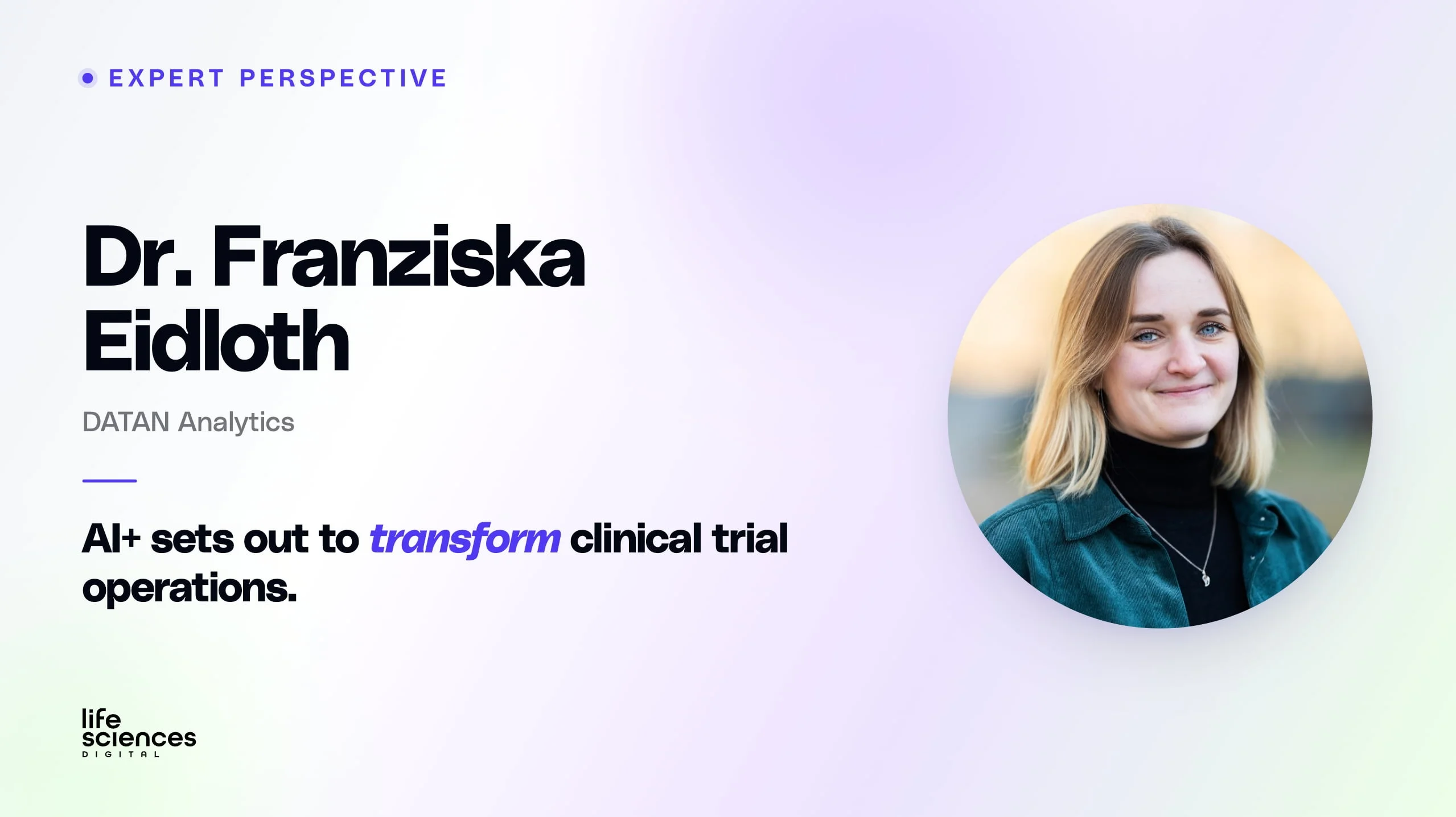
SAP drafting in hours instead of days. SAS code generated in minutes. As the FDA and EMA issue their first joint guidance on AI in submissions, DATAN Analytics is already deploying agents in real clinical workflows. We spoke with Dr. Franziska Eidloth about what this shift means — and what it demands from biostatisticians.
SAP generation automated from days to hours — an 80% reduction in a task that is central to every clinical trial
The FDA and EMA have issued joint guidance on AI in submissions, creating the regulatory green light that was previously missing
AI does not replace biostatisticians — it shifts their role from manual coding to strategic oversight and AI orchestration

What core problem in clinical trial operations is DATAN Analytics AI+ designed to solve?
Dr. Franziska Eidloth: Our company comes into play where repetitive, time-consuming tasks use up resources. Whether it's writing an SAP or SAS code generation, we tailor our approach to where it's most needed. With our expertise in clinical trials and know-how in the sensible application of AI, we work with our customers to identify processes that deliver faster results through automated workflows.
Why is this the right moment for AI automation in clinical statistics — and what has changed recently that makes it viable now?
The current moment for AI automation in clinical statistics is unique because Large Language Models have finally reached the level of reasoning required to handle complex, domain-specific tasks like CDISC-compliant coding and SAP drafting. Beyond the technology itself, we've reached a regulatory green light following recent joint guidance from the FDA and EMA, which provides the first clear framework for using AI in submissions. This shift is further accelerated by intense competitive pressure: organizations are now forced to adopt automation to shave months off trial timelines and manage the exponential increase in data volume. Ultimately, AI has moved from a speculative luxury to a baseline necessity for maintaining operational viability in modern drug development.
AI has moved from a speculative luxury to a baseline necessity for maintaining operational viability in modern drug development.
Dr. Franziska Eidloth, DATAN AnalyticsIn plain language, how does DATAN Analytics AI+ actually work?
The steps vary slightly depending on the agent. In general, developing an agent requires company-specific information about the structure of the desired document or code, what to pay particular attention to and, ideally, examples for guidance. Once the agent is complete, the user only needs to upload the relevant input and let the agent do its job. The automation then runs independently in the background and delivers the result as soon as it is ready. The output should always be double-checked by a human, as AI is not error-free.
Which specific processes does the platform automate today — and where does it create the most dramatic time savings?
The first use case involves the automated generation of a statistical analysis protocol (SAP) based on a study protocol. This process usually takes days and is very time-consuming. Using automation, we were able to reduce this time to hours. We also have a SAS code agent to convert a CDISC-compliant SDTM dataset into an ADaM dataset — hundreds of lines of code, which would otherwise take hours to write, are now generated in minutes.
How does the platform handle regulatory compliance and data security?
Our platform's servers are hosted on an ISO 27001-certified server, as are two local open-source LLMs. Other LLMs are hosted in the EU in compliance with GDPR. Access to the platform is via VPN or fixed IP addresses and two-factor authentication. The platform also has a full audit trail.
What distinguishes your approach from simply using a general-purpose AI tool like ChatGPT for biostatistics work?
Our platform provides a secure environment for your data, using ISO 27001-certified servers and GDPR-compliant LLMs. Our agents are customised for specific tasks — once provided with the relevant input, the agent will perform its tasks accurately and the biostatistician does the eventual review and formal sign-off. That combination of domain specificity, data security, and a human-in-the-loop review model is what makes it usable in a regulated environment.
Who benefits most from DATAN Analytics AI+ today?
So far, we have been working mainly with CROs and some smaller sponsor companies. We assume that a client needs a certain size and work volume to reap the benefits of our automation services.
How do you see AI reshaping the role of biostatisticians and clinical data managers over the next 3–5 years?
Rather than replacing biostatisticians and data managers, AI is shifting their role from manual execution to strategic oversight. Over the next 3–5 years, the augmented statistician will transition from laborious coding and data cleaning to the role of AI orchestrator, focusing on trial design and complex causal inference. Professionals will need to supervise automated workflows and ensure the integrity of AI-generated outputs. Although manual data cleaning tasks will disappear, the need for in-depth clinical judgement will remain critical in order to validate AI logic and defend statistical results to regulators.
How can organizations start working with DATAN Analytics AI+ today?
Following a brief demonstration of our platform, we offer to develop a free proof of concept based on one of the customer's use cases. If the proof of concept is successful, we move on to developing a final agent, the customer receives their own instance, and we provide up to two weeks of onboarding including administrator training. Close cooperation with customers during development is important to us in order to identify any necessary adjustments at an early stage.
DATAN Analytics develops AI agents for clinical development workflows, with a focus on biostatistics and regulatory-grade data processing. The platform is designed specifically for CROs and pharma sponsors handling CDISC-compliant submissions, operating within ISO 27001-certified and GDPR-compliant infrastructure.
AI-powered automation for clinical study workflows—from eCRF design through Clinical Study Report generation, with GDPR compliance.
View Tool →